Who was Sir John Talbot?
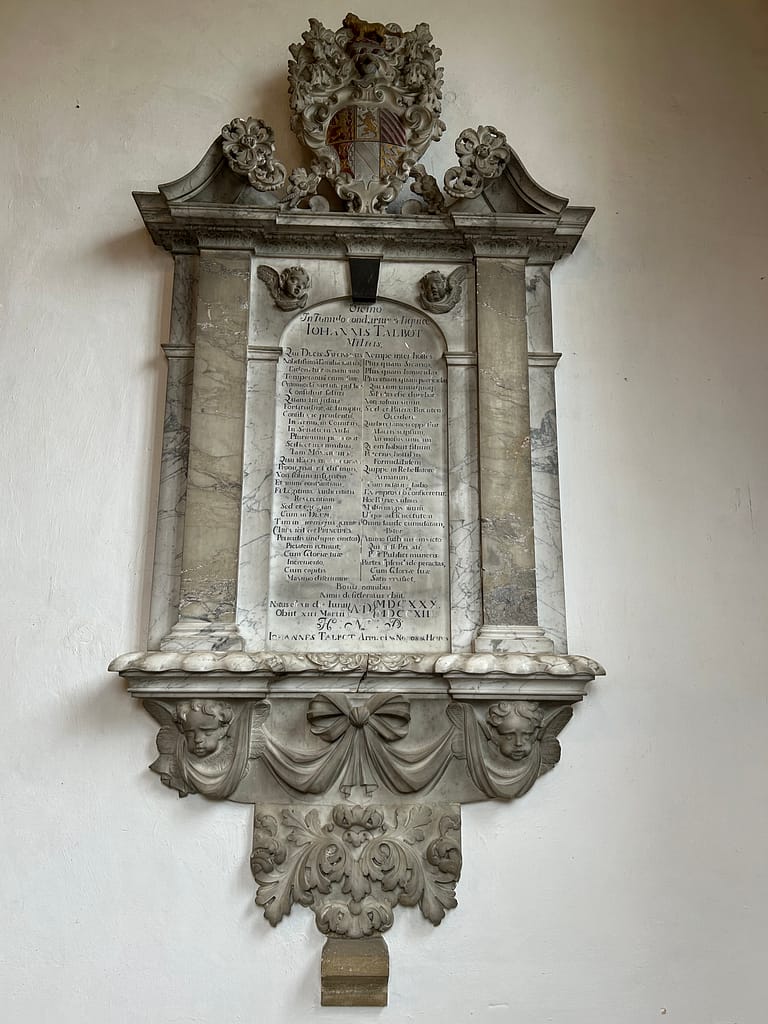
(This memorial is to be found in the chancel of the church on the left of the main altar)
Near this place is buried Sir John Talbot an ardent Royalist born in the reign of King Charles 1 and imprisoned for cospiring to restore the crown. The first man to help King Charles II ashore from his boat on his return to power. Injured as a 2nd in a duel as documented by the famous writer Samuel Pepys.
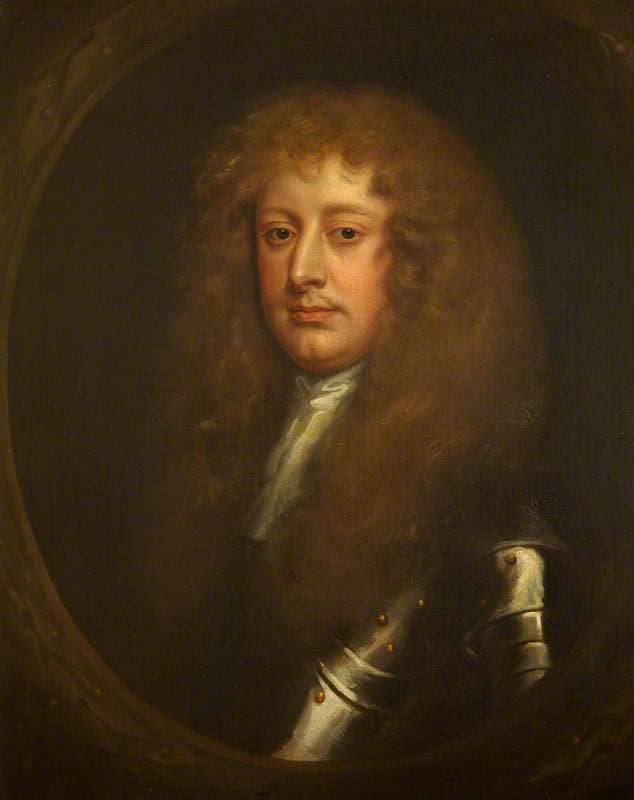
This picture of Sir John Talbot is by Peter Lely
John was born on the 7th of June 1630. He was born into troubled times. Two years before his birth, King Charles I dissolved his parliament and began a disastrous 12-year attempt to rule without its support. By the time the Young Talbot was twelve, the English Civil War had begun.
Sharrington Talbot II, his father, being an ardent royalist, was present in Nottingham when the King raised his standard over the castle, that started the war. Sharrington Talbot II had been made a Colonel in the Captain General’s Regiment of Horse; he was active throughout the war.
Lacock itself would also bear witness to the struggle between the Roundheads and Cavaliers as early as Parliamentary forces moved in and seized the Abbey. With the shifting tides of war, the Roundheads would withdraw, and a royalist garrison would take up residence and hold the village for several years. That was until 1645, when Lacock itself came under siege from Parliamentary forces as they attempted to take control of this royalist outpost following the successful capture of Devizes. Accounts differ on what happened; some claim that Royal Garrison, under Colonel Bovell, fought to defend Lacock. The siege lasted two weeks. Colonel Bovell succeeded in throwing the attackers back and surrendered honourably to Sir Thomas Fairfax after the King’s capture. Other Accounts suggest that Bovell led a counterattack towards Devizes that failed, and others claim he surrendered without a fight, recognising the hopelessness of his situation. In either case, one thing is consistent: none of the Talbots were in residence at the time having fled some time before.
The War did not go well for John’s Father, who was captured in 1645, along with Sir Gilbert, his uncle and the Governor of Tiverton. John’s formative years were shaped by the Civil War, with two passionate royalist figures in his life; his own beliefs were a for gone conclusion. He was fifteen when the war ended and following the execution of Charles I, his son Charles II ended up being a king in exile and John, as a young man, sought ways to serve his king loyally. He was involved in number of loyalist plots to try to restore the monachy. In 1651 he and his cousin Charles Lyttleton attempted to join one of Major General Edward Massey’s plots to overthrow Parliament. With his cousin’s help John began laying the groundwork for this in Worcestershire; however, Masseys’ plan to bring the king back ended in disaster and Charles II fled from England again, while the Royalists all went to ground.
John was arrested the next year and kept in prison for a time but was released a few years later and married his first wife shortly afterwards. Elizabeth Keytt and John had three children together. Sadly, tragedy struck three years later as Elizabeth died in childbirth; she was buried with their new infant son in Stow on the Wold.
In 1658, following the death of Oliver Cromwell, Lord Protector of the English Commonwealth, and the passing of power to Oliver’s son it was clear the nation was fracturing. Alan Brodernick, a royalist organiser, wrote to the banished King Charles II. “I am employed by my Lord Falkland, Mr Howe, Mr John Talbot, Raph Delavel, and many others… to negotiate for them and to procure…his majesties orders.” Recognition and orders came swiftly, and several Royalists approached General Monck, a prominent Scottish noble, who was swayed to the cause of restoration. After a brief conflict in which the parliamentary army collapsed, Charles II landed in England in 1660. John Talbot was there to welcome him and is said to have been the first man to help the restored king ashore. Talbot was knighted on the 6th of June that year. A few years later, Charles II also honoured the Talbots by dining at Lacock abbey.
Celebration seemed to be in the air for all the Royalists as John married his second wife, Barbra Slingsby, in 1660. Her father had been Sir Henry Slingsby, another Royalist, but he had not got so lucky during the final days of the Commonwealth. He had been executed as a traitor by the parliamentarians. However, Barbra brought her father’s connections with her, which would prove useful in John’s later life. They would go on to have more children, though only three daughters would live. Following the restoration, John would pursue a military career. In 1661, he joined the King’s Regiment of Foot, later to be known as the Grenadier Guards. He retired eleven years later as a Lieutenant Colonel.
In a curious episode during his time in the Army, John became involved in a matter of honour between his relative, Francis Talbot, Earl of Shrewsbury, and Sir Robert Holmes, Duke of Buckingham. The Earl of Shrewsbury had become aware that the Duke had taken his wife, Lady Shrewsbury, as a mistress for some years. Her husband had been outraged and challenged the Duke to a duel. What followed was a sizable scandal which was reported by Samuel Pepys. While details are scarce, it seems that Shrewsbury was mortally injured and died a few months later, while the Duke’s Second, Captain Jenkins, was killed in the field of honour, likely by John Talbot, who walked away with slashes on one of his arms. Pepys noted that no one walked away without a scar. It is also rumoured, but not verified, that Lady Shrewbury, disguised as a page, held the Duke of Buckingham’s horse and watched her lover mortally wound her husband. It is also claimed that that night when the lovers lay in bed together, Buckingham wore the blood-stained shirt he had worn when he had mortally wounded her husband. Sadly, this would not be the last duel that John would be impacted by.
In 1679, the second great succession crisis of John’s life kicked off as Charles II died. His younger Catholic brother James II took the throne over the King’s Protestant daughter, Mary II, who was married to William of Orange (the Protestant ruler of the Netherlands). In this hostile climate of political and religious uncertainty, James II managed to alienate all but a few of his supporters. One of them being John Talbot who had stood for office after retiring from active duty, he was elected MP for Chippenham and joined a parliament in shambles. John was in an awkward position; the French ambassador described him as being “Very Protestant and very Royalist.” He achieved re-election in 1681, but the parliament was in such a state that it was dismissed a week later, and he never took his seat.
Four years later, James II finally secured the throne, and John Talbot was elected MP for Devizes in the so-called Loyal Parliament that supported the King. Unfortunately, due to the king’s poor political brinkmanship in forcing through religious changes, this triggered a new rebellion that year.
During this rebellion, Sir John and his eldest son and heir, Sharrington Talbot IV, entered military service. However, though the Monmouth rebellion was quickly put down, his son would never see it. Major Sharrington Talbot IV got into an argument with a Captain of the King’s Militia over the readiness of their troops. Both men were exhausted and strained and decided to settle the matter with pistols. Major Talbot was shot dead on the spot; his killer fled the country after the national outcry at two men of the King’s Militia trying to kill each other during a rebellion.
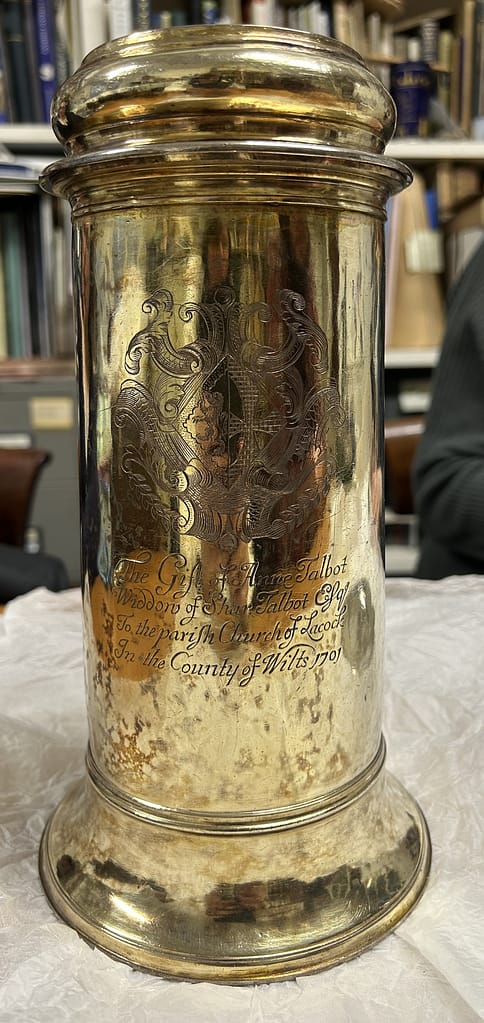
The news devastated the family, none more than Mrs Ann Talbot, who had married the late Major less than two years earlier. They had no children. Mrs Talbot gifted the Lacock Church with a Large Silver Flagon, on it the inscription reads, “The Gift of Ann Talbot, Widow of Shar. Talbot. ESQ” She died in 1702, one year after gifting the Flagon, and is buried under the Lady Chapel at Lacock Church. The Flagon, pictured here, is still in existence and currently on loan to the Bristol Museum.
So John outlived his son, but time and events were moving around him. In 1688, James II’s rule and the Stuart Dynasty came to an end as William of Orange landed a Dutch army in Torbay. In the Glorious Revolution that followed saw the Royalist Army led by Sir John Churchill, Duke of Marlborough, defect to the Dutch King. Mary II and William the Third would take the throne of an England that would never be the same again. But for John it was another revolution and betrayal of the house of Stuart that he had spent his life fighting for. Unwilling to swear allegiance to the new order in 1690, this meant he could no longer hold office. He was far from alone in that. The young men who had campaigned for the restoration of the monarchy were old now, and times had changed. He chose to retire from public life. Though he was briefly arrested during the Jacobite invasion scare in 1692 as James plotted a return. But this time, John seemed uninterested in getting involved and was soon released. After all, he had helped one King come ashore; this one would have to find someone else.
In 1703, Barbra, his faithful and loving wife, died. John would live on another eleven years, finally passing away on the 14th of March 1714. He was 83 years old. The estate would pass to his grandson, John Ivory Talbot upon his death.
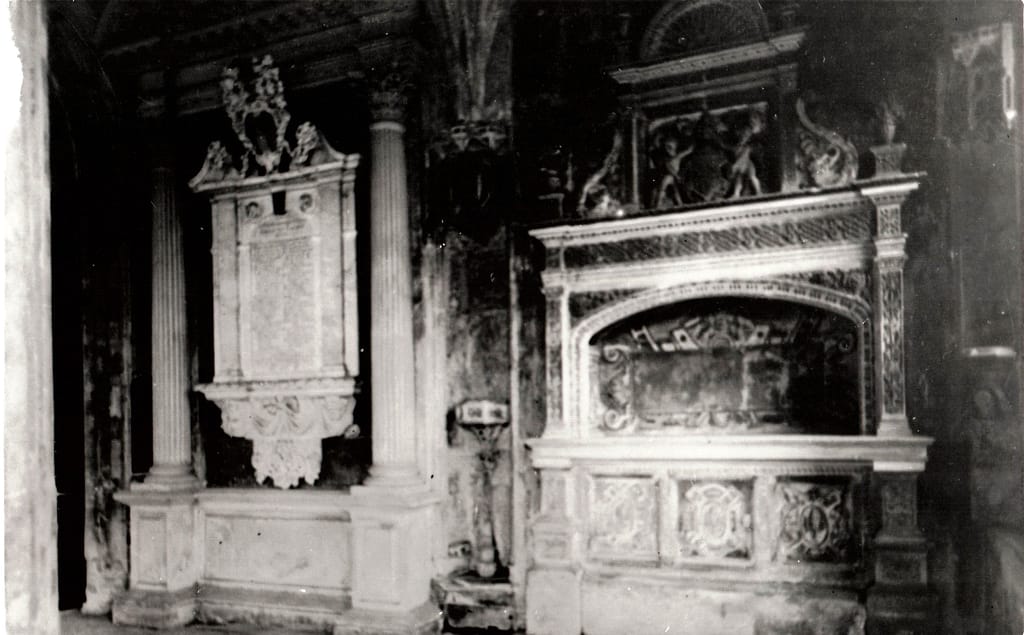
He would be buried in the Talbot (Lady Chapel) of Lacock Church. His memorial, origianlly erected in the chapel itself, was moved in the 19th-century changes to the chancel. Below is a picture where you can see it in its original position in the chapel alongside that of Sir William Sharrington. The top flume from the monument was just left in the churchyard until 1919 when following the end of the 1st world war it was presented to Lacock by Matilda Talbot to be used as an outer casting the war memorial where it is still in place today.