Who was Sir William Sharington?

(This memorial can be found beside the small altar in the Lady Chapel)
Here lies Sir William Sharington, aide to the English envoy sent to Rome seeking the Pope’s blessing on the annulment of King Henry the 8th’s marriage to Catherine of Aragon. First private owner of the dissolved priory of Lacock Abbey and embezzler of the Bristol mint! Imprisoned in the Tower of London and eventually pardoned by the King and finally made Sheriff of Wiltshire!
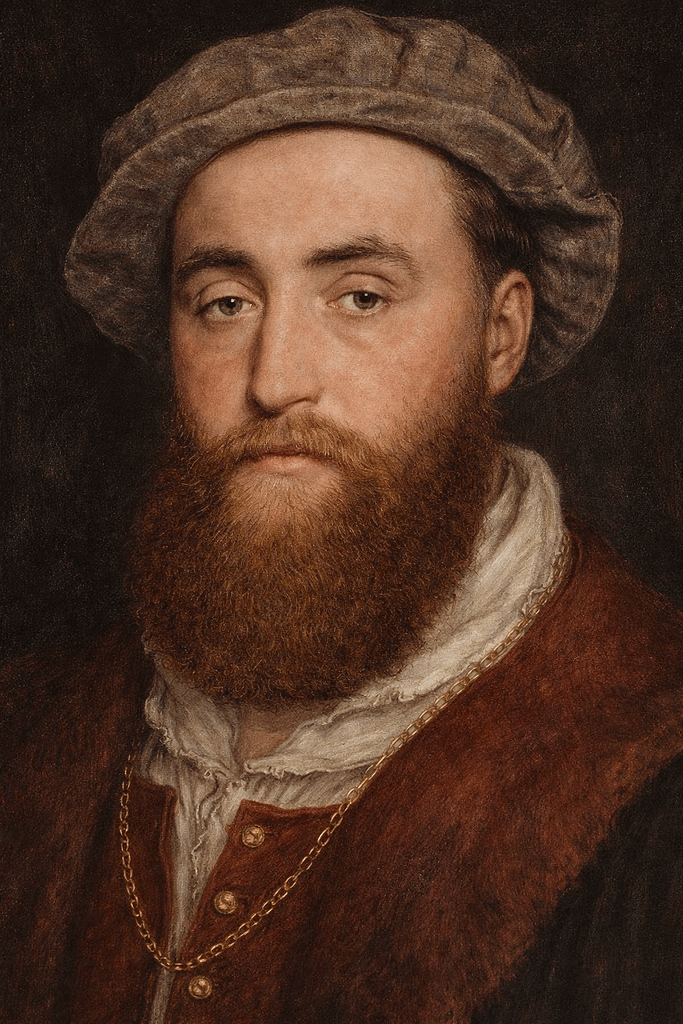
This image is a re-construction from a sketch of him by Holbein
Sharrington was born in the last years of the 1400s; his father was Thomas Sharrington, Esquire of Sharrington. He was born into interesting times as great changes in politics and faith tore through Europe. By the time he was fourteen, there was a new king on the throne who promised an end to the economic tyranny that had dominated his father’s reign. Henry the 8th brought change throughout his reign, be it the changes in court following his father’s reign, to the rise and fall of his various advisers and the marriages they arranged.
Sharrington was able to ride these waves of change in the service of Sir Frances Bryan. He joined his mentor and benefactor in the diplomatic envoy to Rome and attended the negotiations to dissolve the king’s first marriage. The lack of success in the endeavours appears not to have tarnished his image to the king, as he was later made Page of the King’s Robes. In this minor court position, the page assists with carrying the king’s long train on his royal robes on special occasions such as the opening of parliament.
It was during the twilight years of King Henry’s reign that William purchased the now dissoled priory at Lacock and converted it to a private dwelling. He decided to integrate the existing parts of the Abbey into his new home and drew on many of the trends developing in Italy. He likely brought many of the ideas back from his earlier trip to Rome. His tomb is an example of this, and it is considered one of the First early Renaissance memorials in England.
His purchase of such an estate gave him a base in society and he was confirmed as Lord of Lacock Manor in 1540. With such status came new opportunities, as six years later, he was appointed Sub-Treasurer of the Bristol Mint.
Following the King’s Death, a year later, he was inducted into the fellowship of the most noble order of the Bath at the coronation of the new King Edward the 6th, conferring on him a greater status in the nobility. He had already sought such favour using his protestant leanings (such as they were) to create connections with Lord Sir Thomas Seymour of Sudeley, the King’s uncle.
Unfortunately, this also involved him with several financial schemes, the most notable of which involved the illegal purchase of church silver from Parishes across Somerset that was melted down into counterfeit French currency. He is also said to have made the equivalent of 1 million pounds in today’s money by orchestrating the shaving of new coins to create more counterfeit currency.
None of this activity escaped the notice of the authorities, and Sharrington was arrested in 1549. The abbey was searched, and he was locked in the Tower of London. The following year, he gave a full confession of his crimes and, after an intercession from Bishop Hugh Latimer, a notable Protestant. He was given a complete pardon by the king. The Bishop’s intervention was likely driven by his Protestant leanings and by political considerations.
After his brief detention at his majesty’s pleasure, he returned to Lacock and repurchased the estate and the few other properties he had been forced to give up in Wiltshire. Not long afterwards, he was once again employed by the government and sent to Calais to receive the substantial payment the French had negotiated with the British government to recover Boulogne, which had been under English occupation since 1477. The sum he was sent to collect was an eye-watering equivalent to 27.4 million pounds in today’s money. Whether all of it reached the treasury or if Sharrington “lost” some of it along the way is sadly lost to history!
His final appointment would be as Sheriff of Wiltshire in 1552. He would die a year later with no family leaving the estate to his brother Henry Sharrington, who would come to live at Lacock and carry on his improvements to the Abbey.
His monument installed by his brother interestingly the large inscription plate missing and was not there when John Aubrey, the anitquarian visited in the 1670s. Speculation exists that it may have been removed to make bullets for the civil war when there was a garrison at Lacock Abbey but who knows? Before the tomb was installed there was a second window which would have made the chapel a lot lighter.