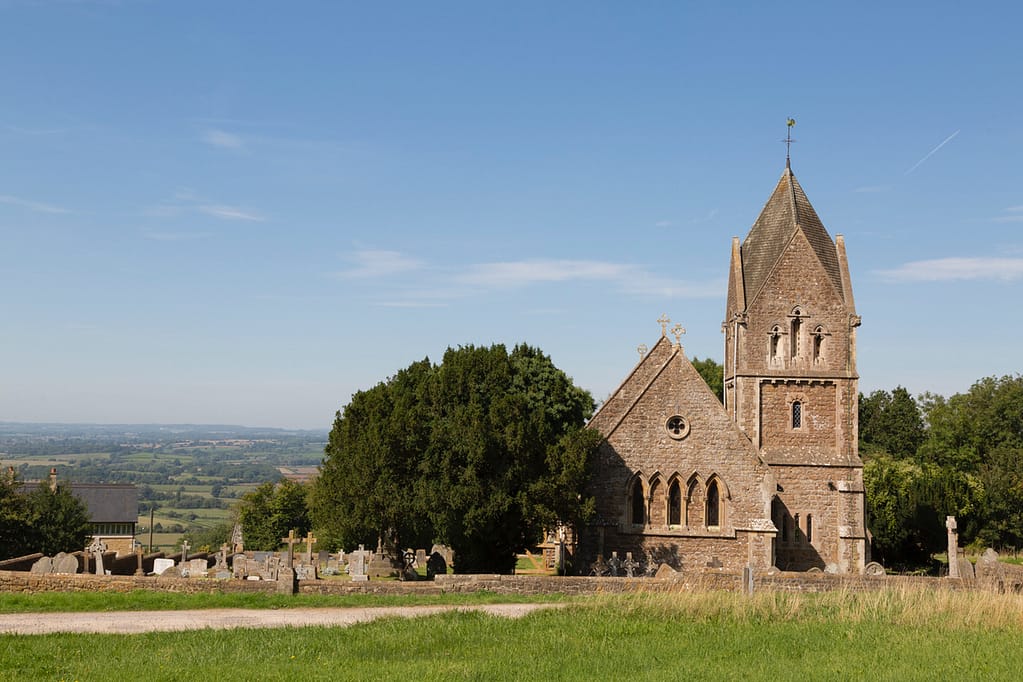
The early years: St Anne’s church was built in 1857 out of love for the residents of Bowden Hill, who previously had to cross the Avon to St Cyriac’s two miles away. The river was liable to flood and the hill to become dangerously dark and slippery in winter, particularly for children.
And children there were. The number of souls on Bowden Hill was increasing in line with the rest of the country. England’s population doubled between the censuses of 1801 and 1851 and would do so again by 1901. This strained churches beyond their capacity, and led Parliament to pass laws encouraging the division of parishes to spread the load.
Retiring from the Royal Navy to Bowden Park in 1849, Captain John Neilson Gladstone (‘JNG’) quickly saw the need for a church to serve the growing Hill community. Being a Member of Parliament, (e.g. Devizes, 1852-57 & 59-63), he also heard the national concern about churches becoming overcrowded.
The birth in November 1855 of his seventh child and long-prayed-for first son, John Evelyn Gladstone (‘JEG’), proved the catalyst for action.
Having conceived of the idea, JNG was keen to pay for it. He also had a design in mind. As a young naval officer, he had admired a Saxon (pre- 1066) church at Sompting on the coast road east of Portsmouth. Its pyramidal Rhenish Helm spire, now known to date from the 1300s, was unique in England. In this he was not alone – the look gained a Victorian following, from Flixton in Suffolk (1856), to Anglican churches in St Moritz, Switzerland (1875), and Jordan Falls, Nova Scotia, Canada (1887).
He was encouraged in his plan by the owner of Lacock Abbey and village, the photographic pioneer, Henry Fox Talbot; and by Bishop James Monk of the diocese of Gloucester and Bristol, as it was in those days.
The foundation stone for St Anne’s was laid on 26 April 1856 by his wife, Elizabeth, and the church was consecrated 28 July 1857. It was quick work.
The choice of St Anne at patron saint of the new church remains to be researched. She is honoured in Christian tradition as the mother of the Virgin Mary. It is notable that JNG’s mother and older sister were named Anne.
The organ, by Bevington of Soho, was donated in 1858 by Elizabeth. A fine vicarage followed in 1860, built on Bowden Park land, on the opposite side of the road halfway down the Hill.
Elizabeth Gladstone died in February 1862 aged 45. JNG survived her by less than a year, dying in January 1863 at the age of 56, from an operation to remove a tumour. He thus missed their dream’s culmination.
The boom years, 1863-1918: The first vicar was installed in March that year, when the parish was finally separated from the old parish of Lacock. In accordance with JEG’s wishes, a large endowment was paid for the diocese to guarantee the provision of a local priest in perpetuity.
The diamond-shaped panel inside St Anne’s on the north wall near the entrance carries JNG’s coat of arms. This mourning escutcheon hung over the front door at Bowden Park for many months after his death. It was restored in 1967 by JEG’s sole grandchild, Mrs Zelda Dunlop, patron of the church from 1960-2014.
See the separate link (below) on stained glass in St Anne’s.
In 1870, the original tower bell, cast by Warner of London, was joined by a JW Benson tower clock with two further bells, given in memory of Mrs Fanny Charlotte Sackville-West. Fanny Charlotte was a first cousin of Mrs Elizabeth Gladstone through Elizabeth’s mother. It was given by Fanny’s widower, Mortimer Sackville-West, subsequently 1st Baron Sackville.
A particular benefit of the new parish was the opening of a Sunday School on the east bank of the Avon. It met in the new vicarage until 1885 when a parish room was built by public subscription opposite the vicar’s home for this and other community activities on Bowden Hill.
In 1908 the footprint of St Anne’s churchyard was doubled to the south, taking up more common land, again with the support of the Fox-Talbots. St Anne’s now occupied the northern part of a square enclosure. One of the last graves was dug in 2014 for Mrs Dunlop, and the graveyard is now considered full.
The interwar years: World War I (1914-1918) proved a turning point. The story is told in part by the ten names on the war memorial, dedicated in August 1920, alongside the Commonwealth War Grave: the human devastation wreaked on local families.
Another effect of the Great War was the mobilisation of women: five Red Cross nurses (VADs) and twenty-nine other ladies from around Bowden Hill had served with distinction on the home front, proving their equality with men. Within ten years, all women aged 21 and over had the vote.
The war also changed the local economy. Pre-1914, employment on Bowden Hill had been in agriculture and forestry, with a little hospitality. Life was based around the local landowners and businessmen, the Spicers at Spye Park, the Merewethers and Harrises at Bowden Hill House and the Gladstones at Bowden Park.
The ruinous cost of World War I fell partly as tax on the rich, which led to them reducing staff on the estates. At the same time, the shortage of men, the mechanisation of farming, the electrification of households and the motorisation of transport, all helped shift rural populations to towns.
Electricity came late to St Anne’s. In September 1933, JEG installed electric lighting in memory of two of his sisters, Misses Alice and Constance Gladstone, who are buried at the east side of the graveyard; and shortly after that the organ gained electric bellows.
World War II and beyond: In WWII, Bowden Park was temporarily requisitioned by the military, and the congregation gained an influx of New Zealanders. JEG, by then a widower and 4th Baronet of Fasque & Balfour, died at home on 12 February 1945 aged 89. He had been patron and squire of the parish for 82 years.
After WWII, the Church of England had to cope with bomb damage across its city estate, and the decimation of its fixed income reserves by inflation. In 1947, an Act of Parliament absolved it of past guarantees to provide vicars in perpetuity and permitted the sale of properties given to it on the promise that they would be held forever. Bowden’s congregation and Sunday school were still healthy. However, when the vicar retired, despite pleas at all levels, including by the new patron, JNG’s daughter, Ivy, Lady Hollenden, the diocese chose to raise money and cut costs by selling the vicarage and returning the parish to Lacock. The argument was, that the motorcar put St Anne’s within the range of the Rector of Lacock.
The merger took place in 1955. The Sunday school, the link between St Anne’s and its future, was disbanded. The vicarage was sold in 1960, and the proceeds went to Bristol, on the promise that this would increase the diocese’s contribution to financing the parish. In 1980 the Bowden Hill Parish Room was demolished.
Still St Anne’s inspired Christian faith and affection. The tower clock was repaired by public subscription in 2000, encouraged by the Burnett Brown family at Lacock Abbey. In 2008 the local ladies began a seven-year project to make new needlework kneelers. In 2015 the clock was given an electric winding motor, paid for by teas served at Bowden Park open days, and donations. The stained-glass windows were restored that year in memory of Mrs Dunlop, and new altar cloths donated.
In late 2018, by when Sunday services were monthly, a buttress in the south wall of St Anne’s moved outwards and cracked the chancel arch. It was temporarily propped externally. In 2019, Friends of St Anne’s (FoSA) was formed announcing major fundraising plans for 2020.
The covid lockdown in March 2020 put paid to FoSA’s first campaign. Then, in August the shifting buttress was deemed to have become a danger to worshipers and the church sealed off, with scaffolding erected inside and out. The PCC decided to save the church in a phased approach, starting with the buttress. That summer also FoSA paid for restoration of the entrance gateposts, ornamental iron arch and gate; and the following year for repairs to the south wall of the graveyard.
Over the winter of 2023-4 the PCC financed the main structural repair, undertaken by Carrek of Bristol, with Chris King master mason, and Marcus Chantrey architect. The graveyard retaining walls either side of the entrance were also rebuilt, with FoSA paying for the western side. The buttress-work won a Diocesan architectural award in November 2024, Bishop Viv Faull praising the ambition to open the church for wider community use; and was runner-up for the National Churches Trust gold medal.
Footnote – A Prime Minister in the pew: The four-times British Prime Minister, William Ewart Gladstone (‘WEG’), was JNG’s youngest brother. He attended the consecration of St Anne’s. The two were close, and WEG was JNG’s executor. He became the seven-year-old JEG’s guardian and arranged his education in the image of his own – Eton and Christ Church, Oxford. WEG remained an attentive uncle – in November 1870 as Prime Minister he received news of the fall of Metz, a turning point in the Franco-Prussian War, while witnessing the wedding at St Anne’s of his niece, JNG’s fifth daughter, Edith.
The Treasure-trove of Victorian and Edwardian Stained Glass
The Churchyard
The Churchyard at St Anne’s is still open for family cremation or those with a connection to the Church. We have a full plan of the graveyard post-1908 so if you are looking for a grave location please contact info@lacockchurches.org.uk
Parish Records
The older parish records for St Anne’s are held at the Wiltshire History Centre in Chippenham, however we do have a transcript of what they contain held at the church so again for any enquiries please email info@lacockchurches.org.uk